Category Archives: MikroTik Certified

MikroTik Certified Security Engineer (MTCSE)

La certificazione rilasciata da MikroTik sulla sicurezza è:


MikroTik Certified Security Engineer (MTCSE)


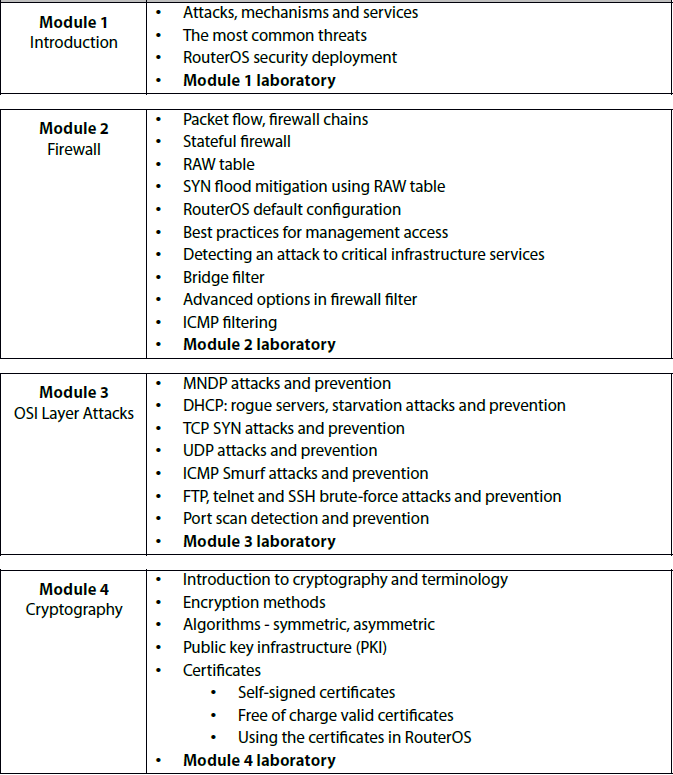
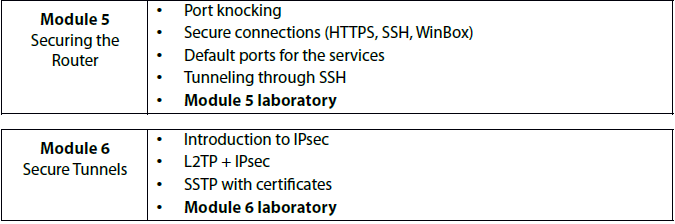
La Certificazione MTCSE è il percorso formativo MikroTik su tematiche di sicurezza delle reti, il partecipante sarà in grado di pianificare e implementare misure di sicurezza appropriate adatte alle proprie infrastrutture e clienti.

Questi gli argomenti che vengono trattati nel corso MTCSE:


MikroTik Certified Network Associate MTCNA

La prima certificazione rilasciata da MikroTik è:


MikroTik Certified Network Associate ( MTCNA )


Il corso MTCNA è rivolto a WISP, internet service provider, sistemisti di rete e system integrators per conoscere il sistema MikroTik RouterOS.
 
La Certificazione MTCNA è alla base del sistema formativo Ufficiale MikroTik ed è indispensabile per accedere ai corsi di approndimento e specializzazione.

Questi gli argomenti che vengono trattati nel corso MTCNA:
 

Module 1
Introduction
•     About MikroTik
•     What is RouterOS
•     What is RouterBoard
•     First time accessing the router
•     Winbox and MAC-Winbox
•     Webfig and Quickset
•     RouterOS command line interface (CLI)
•     Null Modem cable
•     SSH and Telnet
•     New terminal in Winbox/Webfig
•     RouterOS CLI principles
•     <tab>, double <tab>, “?”, navigation
•     command history and its benefits
•     Initial configuration (Internet access)
•     WAN DHCP-client
•     LAN IP address and default gateway
•     Basic Firewall – NAT masquerade
•     Upgrading RouterOS
•     Package types
•     Ways of upgrading
•     RouterBOOT firmware upgrade
•     Manage RouterOS logins
•     Manage RouterOS services
•     Managing configuration backups
•     Saving and reload backup
•     Editing export file
•     RouterOS license
•     Levels
•     Updating a license
•     Netinstall
•     Reinstall RouterOS
•     Reset RouterOS
•     Sources of additional information
•     http://wiki.mikrotik.com/wiki/Manual:TOC
•     http://www.tiktube.com/
•     http://forum.mikrotik.com/
•     Distributor and consultant support
•     support@mikrotik.com
•     Module 1 laboratory
 
 
Module 2
Routing
•     Routing overview
•     Routing concepts
•     Route flags
•     Static routing
•     Creating routes
•     Setting default route
•     Manage dynamic routes
•     Implementing static routing on simple network
•     Module 2 laboratory
 
 
Module 3
Bridging
•     Bridging overview
•     Bridge concepts
•     Creating bridges
•     Adding ports to bridges
•     Module 3 laboratory
 
 
Module 4
Wireless
•     802.11n Concepts
•     Frequencies (bands, channels, advanced channels) data-rates /HT chains (Tx power, rx sensitivity, country regulations)
•     Legacy 802.11a/b/g stuff
•     Setup simple wireless link
•     Access Point configuration
•     Station configuration
•     MAC-address filtering
•     Default-authentication
•     Access-list
•     Connect-list
•     Default-forwarding
•     Wireless Security and Encryption
•     WPA-PSK
•     WPA2-PSK
•     MikroTik wireless protocols
•     NV2 (TDMA) configuration
•     Monitoring Tools
•     Wireless scan
•     Snooper
•     Registration table
•     Bridge wireless networks
•     Station-bridge
•     Module 4 laboratory
 
 
Module 5
Network Management
•     ARP
•     ARP modes
•     RouterOS ARP table
•     DHCP server and client
•     DHCP client
•     Server setup
•     Leases management
•     DHCP-server network configuration
•     RouterOS tools
•     E-mail
•     Netwatch
•     Ping, Traceroute
•     Profiler (CPU load)
•     Contacting  support@mikrotik.com
•     supout.rif, autosupout.rif and viewer
•     /system logging and debug logs
•     readable configuration (item comments and names)
•     network diagrams
•     Module 5 laboratory
 
 
Module 6
Firewall
•     Firewall principles
•     Connection tracking and states
•     Structure, chains and actions
•     Firewall Filter in action
•     Filter actions
•     Protecting your router (input)
•     Protection your customers (forward)
•     Basic Address-List
•     Source NAT
•     Masquerade and src-nat action
•     Destination NAT
•     dst-nat and redirect action
•     Module 6 laboratory
 
 
Module 7
QoS
•     Simple Queue
•     Target
•     Destinations
•     Max-limit and limit-at
•     Bursting
•     One Simple queue for whole network (PCQ)
•     pcq-rate configuration
•     pcq-limit configuration
•     Monitoring
•     Interface traffic monitor
•     Torch
•     Graphs
•     SNMP
•     Module 7 laboratory
 
 
Module 8
Tunnels
•     PPP settings
•     ppp profile
•     ppp secret
•     ppp status
•     IP pool
•     Creating pool
•     Managing ranges
•     Assigning to service
•     Secure local network
•     PPPoE service-name
•     Create PPPoE server
•     Point-to-point addresses
•     Creating PPPoE clients on RouterOS
•     Secure remote networks communication
•     PPTP client and PPTP server
•     SSTP client and SSTP server without certificates
•     Setup routes between networks
•     Module 8 laboratory
 

MikroTik Certified Routing Engineer MTCRE

La prima certificazione avanzata sul routing rilasciata da MikroTik è
mtcre

MikroTik Certified Routing Engineer ( MTCRE )


Rivolto a WISP, internet service provider, sistemisti di rete e system integrators per conoscere approfonditamente il routing, in particolare OSPF, su MikroTik RouterOS.
La Certificazione MTCRE è di primaria importanza per tutti coloro che necessitano di utilizzare protocolli di routing, ed in particolare OSPF, oltre a IPIP, EoIP, PPTP, SSTP, L2TP, Vlan e VRRP.
La Certificazione MTCRE è inoltre un requisito per accedere al Corso di Certificazione 
MTCINE – MikroTik Certified Inter-networking Engineer.

ATTENZIONE: Per poter partecipare al corso MTCRE è indispensabile essere già in possesso della Certificazione MTCNA.

Questi gli argomenti che vengono trattati nel corso MTCRE:

MikroTik Certified Inter-networking Engineer MTCINE

La certificazione avanzata sul routing avanzato rilasciata da MikroTik è


MikroTik Certified Inter-networking Engineer ( MTCINE )


Rivolto a WISP, internet service provider, sistemisti di rete e system integrators per conoscere il sistema MikroTik RouterOS.
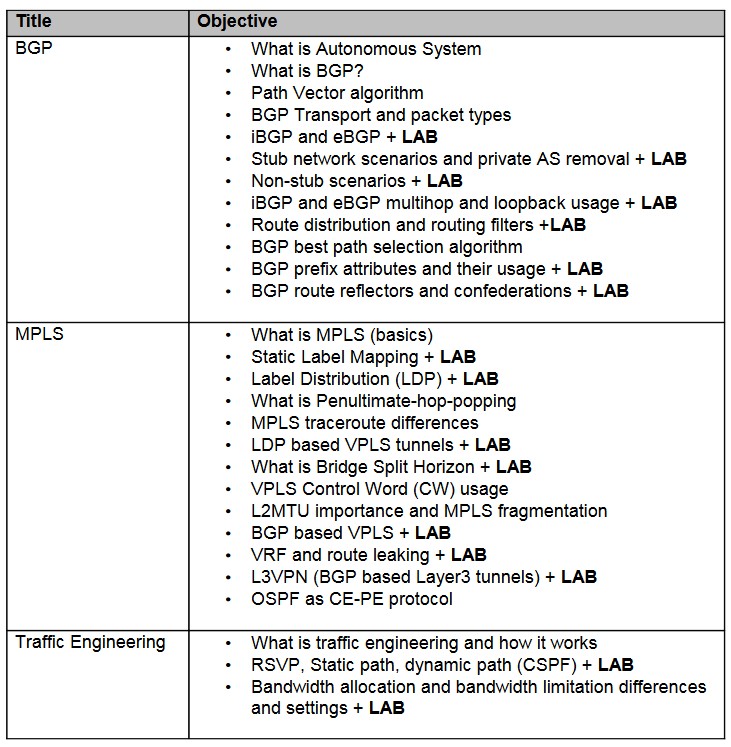
La Certificazione MTCINE è di primaria importanza per tutti coloro che necessitano di utilizzare iBGP and eBGP, Route distribution and routing filtes, Multicast, MPLS, LDP based VPLS tunnels, BGP based VPLS, VRF, L3VPN, OSPF as CE-PE protocol, Traffic Engineering.

ATTENZIONE: Per poter partecipare al corso MTCINE è indispensabile essere già in possesso della Certificazione MTCRE.


Questi gli argomenti che vengono trattati nel corso MTCINE:

MTCINE

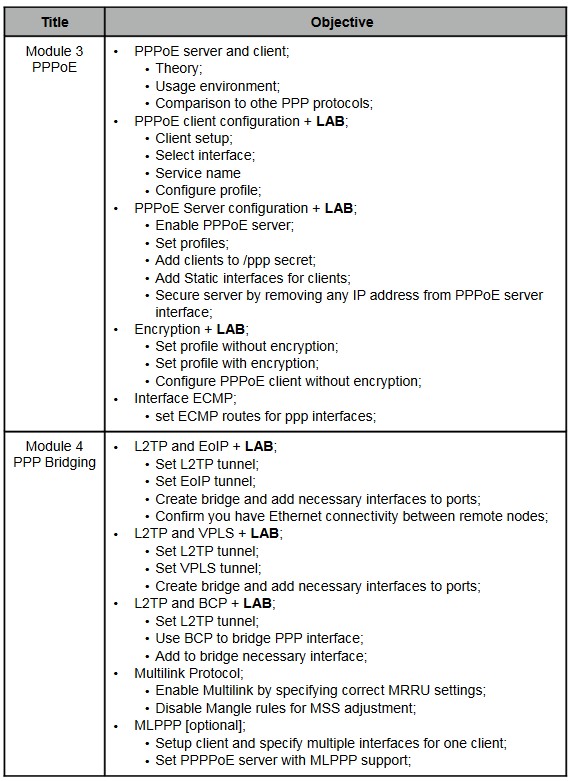
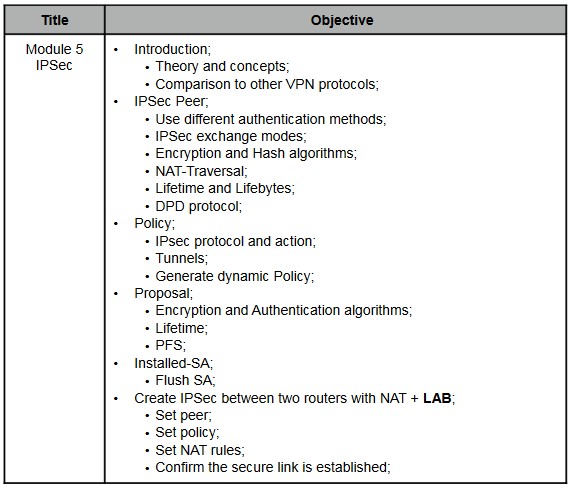
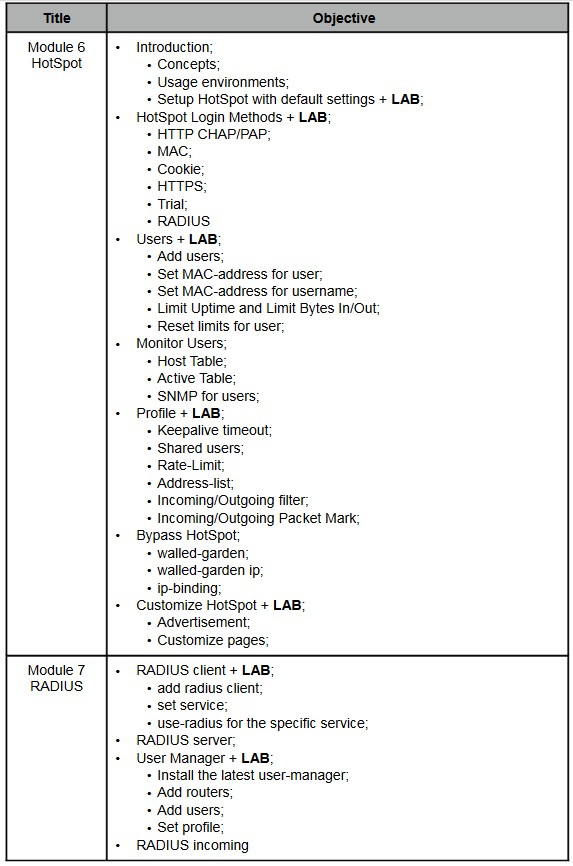
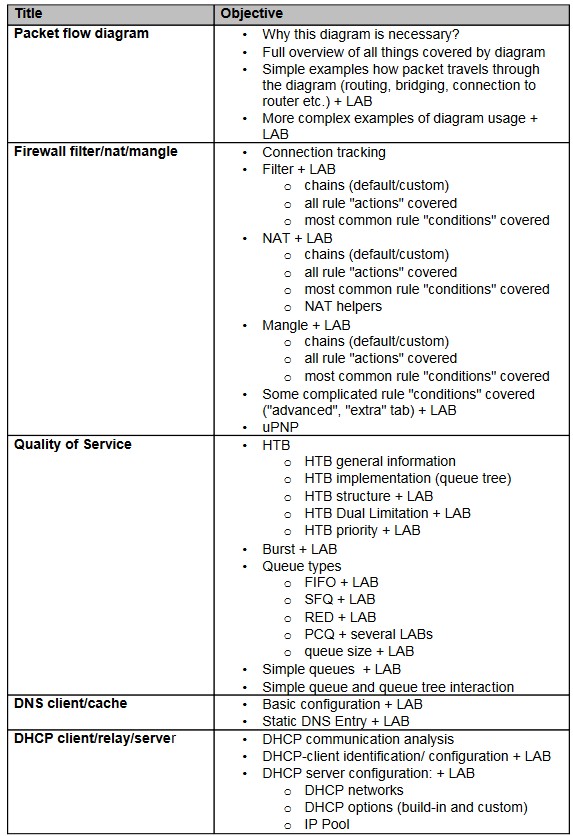
MikroTik Certified User Management Engineer – MTCUME

La certificazione avanzata sulla gestione degli utenti rilasciata da MikroTik è


MikroTik Certified User Management Engineer ( MTCUME )


Rivolto a WISP, internet service provider, sistemisti di rete e system integrators per conoscere il sistema MikroTik RouterOS.
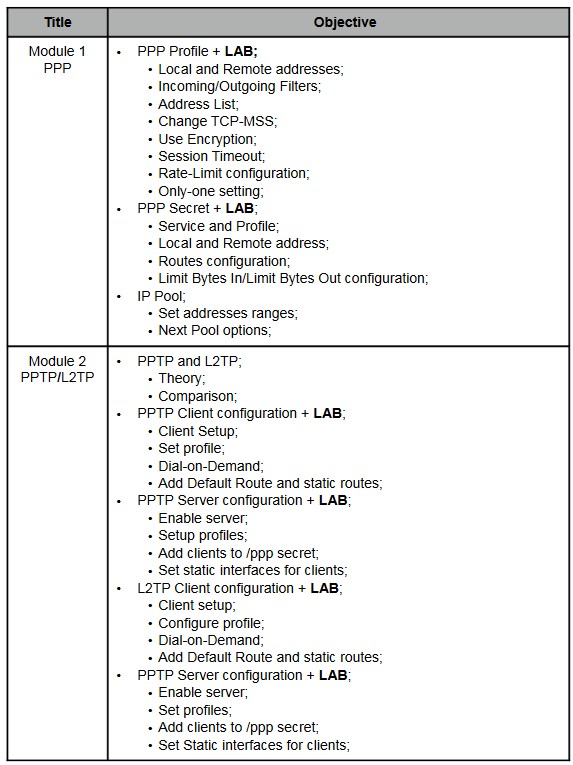
La Certificazione MTCUME è di primaria importanza per tutti coloro che necessitano di utilizzare VPN, connessioni PPP, Radius ed Hotspot.

ATTENZIONE: Per poter partecipare al corso MTCUME è indispensabile essere già in possesso della Certificazione MTCNA.


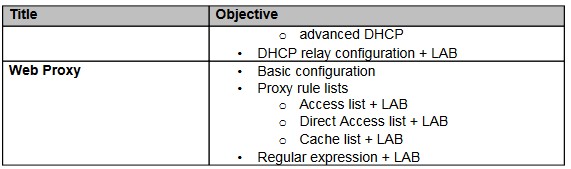
Questi gli argomenti che vengono trattati nel corso MTCUME:

MTCUME 1
MTCUME 2
MTCUME 3
MTCUME 4

MikroTik Certified Traffic Control Engineer MTCTCE

La certificazione avanzata sul controllo del traffico rilasciata da MikroTik è

MikroTik Certified Traffic Control Engineer ( MTCTCE )


Rivolto a WISP, internet service provider, sistemisti di rete e system integrators che desiderano conoscere approfonditamente le configurazioni ed i protocolli wireless su MikroTik RouterOS.

ATTENZIONE: Per poter partecipare al corso MTCTCE è indispensabile essere già in possesso della Certificazione MTCNA.


Questi gli argomenti che vengono trattati nel corso MTCTCE:

mtctce 1
mtctce2

MikroTik Certified Wireless Engineer MTCWE

La certificazione avanzata sul wireless rilasciata da MikroTik è
mtcwe


MikroTik Certified Wireless Engineer ( MTCWE )


Rivolto a WISP, internet service provider, sistemisti di rete e system integrators che desiderano conoscere approfonditamente le configurazioni ed i protocolli wireless su MikroTik RouterOS.
La Certificazione MTCWE è di primaria importanza per tutti coloro che necessitano di utilizzare 802.11 a/b/g/n, sicurezza e protezione delle reti, i protocolli Nstreme e Nv2, WDS, Mesh, ottimizzazione e troubleshooting di reti wireless.

ATTENZIONE: Per poter partecipare al corso MTCWE è indispensabile essere già in possesso della Certificazione MTCNA.


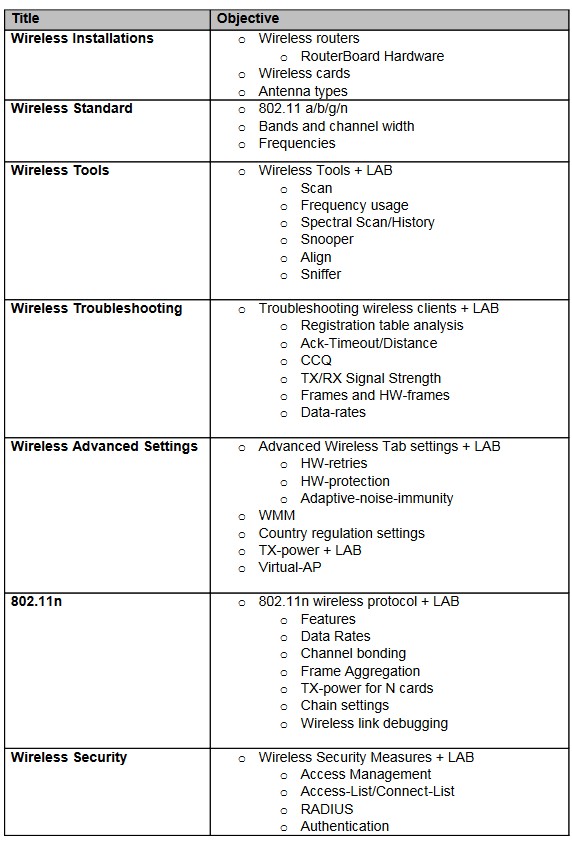
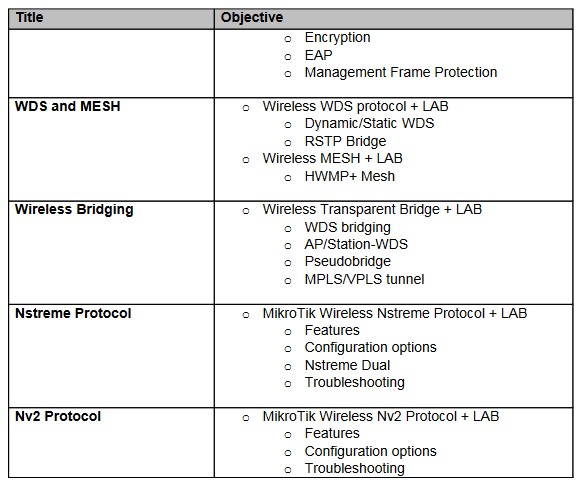
Questi gli argomenti che vengono trattati nel corso MTCWE:

mtcwe 1
mtcwe2


Copy Protected by Chetan's WP-Copyprotect.